
Local SEO for Multi-Branch UAE Businesses: Structuring Location Pages That Rank

A facilities management company with real offices in Dubai, Abu Dhabi, and Sharjah launches three location pages in an afternoon — same layout, same paragraph with the city name swapped, same stock photo. Six months later, none of the three pages rank for anything. The company's single generic homepage still outranks all three for “facilities management Sharjah,” a search happening twenty minutes from the branch that should own it.
This is the most common structural mistake multi-branch UAE businesses make, and it is entirely avoidable. Google does not penalise you for having multiple locations near each other. Dubai's districts alone (Business Bay, JLT, Marina, DIFC, Jumeirah) sit within a few kilometres of one another, and plenty of legitimate multi-branch businesses serve all of them. What Google does penalise, functionally if not literally, is near-duplicate pages that give it no reason to rank one over another.
This guide covers the architecture, the content differentiation, the NAP consistency, and the structured data that turn a set of location pages from a liability into your strongest local ranking asset.
The Duplicate Content Trap Multi-Branch UAE Businesses Fall Into
Search engines evaluate location pages the same way a human visitor would. If the Business Bay page and the JLT page read identically except for a swapped district name, there is no signal telling Google which one genuinely serves which audience. Both compete against each other for the same rankings instead of each owning its own territory. This is called keyword cannibalisation, and in multi-branch local SEO it is the single biggest reason expensive location-page rollouts fail to move rankings.
The fix is not more pages or more keywords — it is more genuine, location-specific substance per page:
- Real staff at that branch
- Real landmarks and parking notes relevant to that district
- Real testimonials from that location's actual customers
- Service details that reflect what that branch actually offers — which frequently differs slightly from branch to branch even within the same brand
Who This Guide Is For
This is written for UAE businesses with either genuine physical branches in more than one emirate or district — clinics, gyms, restaurants, car service centres, real estate brokerages, salons — or businesses with one physical base serving a wide, defined service area across Dubai and neighbouring emirates. If you have not yet set up your Google Business Profile correctly for each location, start with our checklist on Google Business Profile optimisation for Dubai SMEs before building the pages below. The two work together — GBP without matching website architecture leaves ranking potential on the table.
URL and Information Architecture for Location Pages
Structure location pages as clean, flat, individual URLs under a single locations directory — for example yoursite.ae/locations/business-bay, yoursite.ae/locations/jlt, yoursite.ae/locations/difc. Don't bury them under service categories, and don't leave them as unlinked landing pages built for ads only. A flat, discoverable structure lets Google crawl and understand the full network of locations as a coherent set, and lets customers navigate between branches naturally if they searched for the wrong one.
Every location page needs a locations index page linking to all branches. Every individual location page should link back to that index and to its two or three geographically nearest sibling locations — a Marina page linking to the JLT and Business Bay pages, for instance. This internal linking pattern reinforces to Google that these are related-but-distinct entities, not a single diluted concept spread across duplicate URLs.
Resist the temptation to add a location purely for SEO reach without a genuine service presence there. A single-address business publishing ten location pages for districts it does not actually serve is easy for Google to identify as thin content. It's also increasingly easy for customers to identify as misleading, when they arrive expecting a nearby branch that does not exist.
Writing Genuinely Unique Content for Near-Identical Locations
The realistic goal for a chain of similar branches is sixty to seventy percent unique content per page — not a complete rewrite from scratch for every location. That's unrealistic at scale and not what ranking requires. Focus differentiation on the elements that are genuinely different:
- The branch manager or lead specialist, by name
- The specific parking or metro access relevant to that address — critical in Dubai, where finding street parking near Business Bay towers is a very different experience from parking near a Jumeirah villa community
- The district-specific landmarks customers use for wayfinding
- Testimonials collected from that location's actual customers, rather than a pooled company-wide review feed
Where services genuinely differ by branch — a DIFC office offering corporate legal services that the Jumeirah branch does not, for example — state that explicitly rather than listing an identical service menu everywhere. This single change often does more for differentiation than any amount of rewritten filler text. It reflects a real operational difference Google's systems can detect through entity and topic analysis, not just word substitution.
Avoid the reverse mistake too: do not stuff each page with every district-related keyword variation in an attempt to cover more search terms. A JLT page trying to also rank for Marina and Business Bay searches by mentioning them repeatedly typically ranks worse for all three than three focused, distinct pages would.
NAP Consistency Across Google Business Profile and Citations
Name, address, and phone number (NAP) consistency across your website, each Google Business Profile, and every third-party citation — UAE-specific directories, industry listings, and vertical platforms where relevant — remains one of the most underrated local ranking factors. It's also one of the easiest to get wrong across multiple branches. A phone number formatted as +971 4 XXX XXXX on the website but 04 XXX XXXX on a directory listing, or a suite number present on one citation and missing on another, introduces exactly the kind of inconsistency that erodes Google's confidence in which entity is which.
Build a single master spreadsheet listing the exact, character-for-character NAP details for every branch. Audit it quarterly against the live website, every Google Business Profile, and your top ten citation sources. This becomes significantly more important, not less, as you add branches: a five-location business has five times the surface area for a NAP mismatch to quietly appear and suppress rankings, without any obvious symptom other than a slow decline in map-pack visibility.
Suite and floor numbers deserve particular care in Dubai's tower-dense commercial districts like DIFC and Business Bay, where a citation missing a floor number can genuinely misdirect a customer, not just confuse a crawler. Treat address precision as a customer-experience issue as much as an SEO one.
LocalBusiness Structured Data for Each Location Page
Every individual location page should carry its own LocalBusiness schema markup (or the more specific subtype relevant to your industry — MedicalClinic, Restaurant, AutomotiveBusiness, and similar schema.org types all extend LocalBusiness). That schema needs that branch's exact name, address, phone number, opening hours, geo-coordinates, and price range where relevant. Do not reuse one organisation-wide schema block across every location page — each page needs schema describing that specific branch, matching the visible on-page content exactly.
Include the sameAs property linking to that branch's specific Google Business Profile where you have set up separate profiles per branch. This reinforces the entity connection between your website and your Maps presence. Test every location page's structured data individually after publishing, rather than assuming a template applied correctly everywhere — a single copy-paste error in one branch's coordinates or hours can go unnoticed for months while quietly confusing both search engines and any customers who see incorrect hours in rich results.
For businesses with genuinely one physical base but a defined multi-district service area rather than real branches, use a single LocalBusiness schema on your main location page and list the areaServed property with your actual service districts. Don't fabricate schema for locations you do not physically occupy — this distinction matters for the next section.
Multi-Emirate Physical Presence vs a Single Location Claiming a Large Service Area
These are two fundamentally different SEO situations that require different structures, and conflating them is where many UAE businesses go wrong. A business with real offices in Dubai, Sharjah, and Abu Dhabi should build genuine, individually optimised location pages and separate Google Business Profiles for each, following everything above. The physical presence supports real differentiation and real local trust signals.
A business with one physical base in, say, Al Quoz, that delivers services across Dubai, Sharjah, and Ajman without a second office should not fabricate location pages for districts it does not occupy. Instead, configure the single Google Business Profile as a service-area business (see our GBP checklist for the mechanics). Build service-area content on the website that is honest about a single base with a defined coverage zone — content like “AC maintenance across Dubai and Sharjah” rather than a fake “Sharjah branch” page implying a physical office that does not exist.
Google has become increasingly effective at identifying fabricated locations, whether through inconsistent signals, verification checks, or simply customers reporting an address that turns out to be a virtual office or empty unit. The reputational and ranking risk of a discovered fake location — including potential suspension of the associated Google Business Profile — far outweighs the short-term visibility gain. For real-estate-heavy sectors like property brokerages, where RERA registration ties a licence to a specific physical office, misrepresenting location can create regulatory complications well beyond SEO.
Frequently Asked Questions
Ready to Structure Location Pages That Actually Rank?
Before building out location pages, make sure each branch's Google Business Profile is fully optimised — start with our Google Business Profile checklist for Dubai SMEs. For a full local SEO architecture audit across your branches, see our SEO services for UAE businesses, or book a free consultation at as86.pro or WhatsApp us on +971 52 130 0516 — bilingual service available in English and Arabic across all UAE markets.

Written by Amir Sibaee
Google Ads & Media Buying Specialist · SEO/SEM · Marketing Automation ·...
More about Amir →Related Reading
-
 Google Says GEO Isn't a Separate Strategy From SEO— What That Actually Means for Dubai Businesses
-
 AI Overviews vs AI Mode: What Changed in Google Search in 2026 (And What Dubai Businesses Should Do About It)
-
 Shopify SEO in Dubai: Best Practices, Common Pitfalls & How to Fix Them
-
 Google FAQ Rich Results Dead from May 2026 — What Dubai SEOs Must Do Now
Want this done for your business? See my Search Engine Optimization services in Dubai.
Latest Posts
-
 How to Set Up TikTok Shop in the UAE: A Step-by-Step 2026 Seller Guide
-
 Google Consent Mode v2 Setup Guide for Dubai Websites Advertising to the EU
-
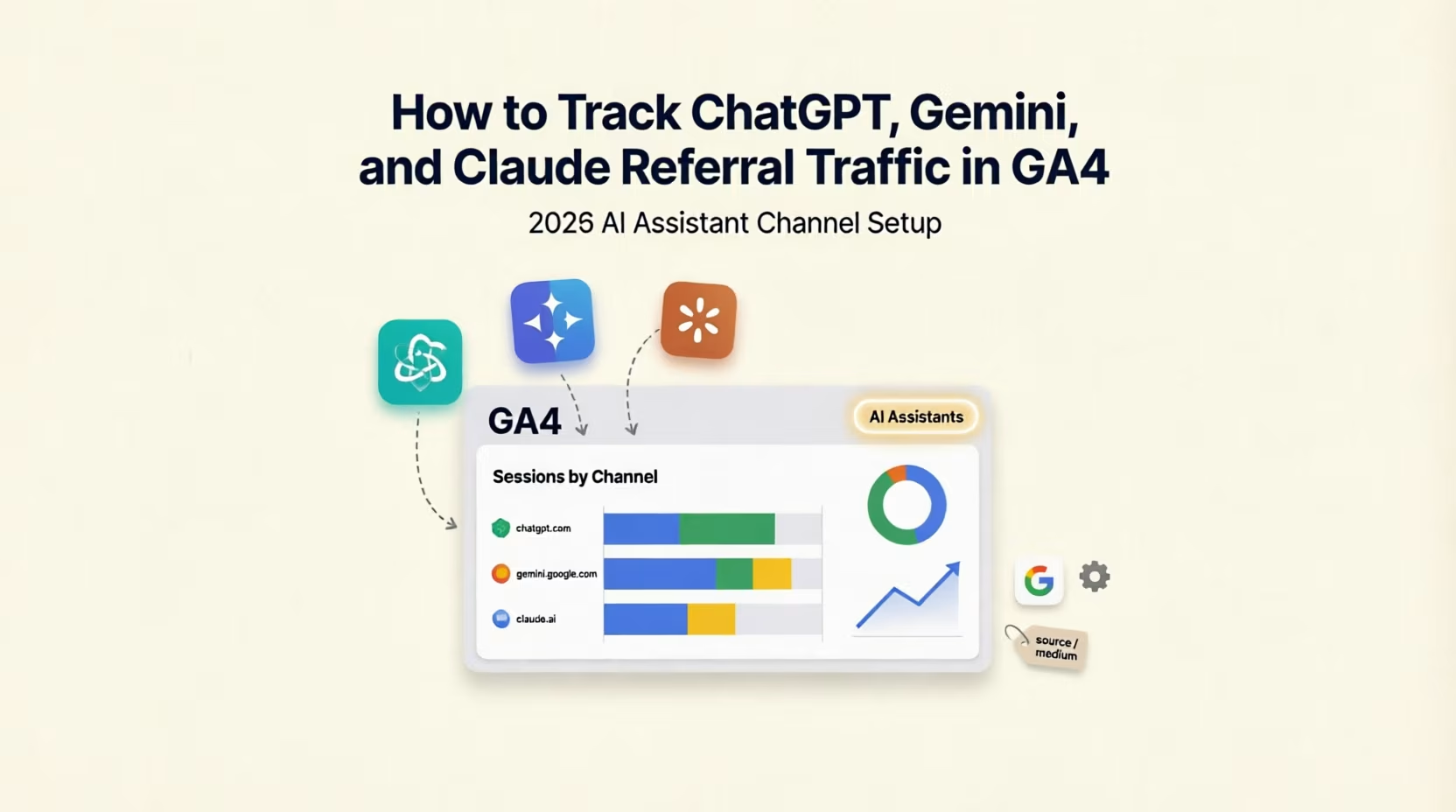 How to Track ChatGPT, Gemini, and Claude Referral Traffic in GA4 (2026 AI Assistant Channel Setup)
-
 Two Critical WordPress Vulnerabilities Patched in August 2026 — Update Your Dubai Site Now
-
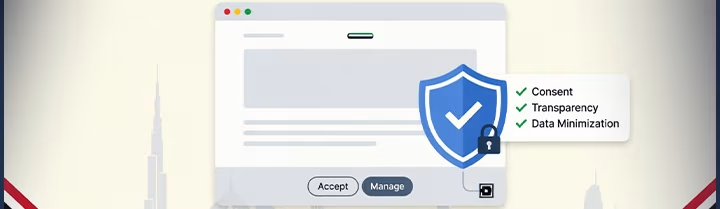 UAE PDPL Compliance for Marketers: What Your Tracking Pixels Actually Need in 2026
-
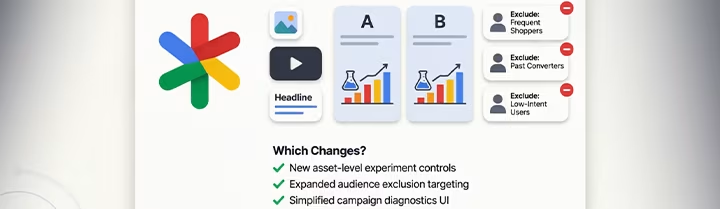 Performance Max in 2026: Asset Experiments, New Audience Exclusions, and What Actually Changed
-
 Should You Let an AI Agent Run Your Ad Campaigns? A Dubai Marketer's Honest Take
-
AI Overviews vs AI Mode: What Changed in Google Search in 2026 (And What Dubai Businesses Should Do About It)
-
 Google Ads Is Removing Language Targeting From Search in September 2026 & What It Means for Your EN/AR Campaigns
-
Google Says GEO Isn't a Separate Strategy From SEO— What That Actually Means for Dubai Businesses
Get a Growth Plan, Not Just a Quote
Seeking expert digital marketing, web design, or graphic design in the UAE? Let's discuss your project and deliver tailored solutions for measurable growth.
Book Free Consultation