
CRO in Dubai: The Framework Behind Every Conversion Audit We Run

A Dubai business owner comes to us with a familiar complaint: traffic is up, rankings have improved, the Google Ads account is spending efficiently — and revenue has barely moved. The instinct is to blame the channel. Switch agencies, try a new keyword set, increase the budget. Almost none of that addresses the actual problem, which usually has nothing to do with how visitors arrive and everything to do with what happens after they land.
This is the gap Conversion Rate Optimization exists to close, and it is the part of digital marketing most UAE businesses skip entirely. SEO and PPC are demand-generation disciplines — they get qualified people to your site. CRO is what turns that traffic into enquiries, bookings, and sales. A site that converts at a mediocre rate but gets more traffic will always look like it is “working,” right up until you calculate cost per acquisition and realize you are leaving a large share of paid-for visitors on the table with nothing to show for it.
We are asked often enough what a CRO audit actually involves that it deserves its own answer, rather than a paragraph buried inside an SEO or PPC service page. This post is that answer — the exact framework we run for every CRO engagement, the UAE-specific factors that change how it is applied here versus anywhere else, and how it connects to the SEO and paid media work most agencies treat as the whole job.
What CRO Actually Is (and What It Is Not)
Conversion Rate Optimization gets reduced, unfairly, to “changing the button color” or “trying a different headline.” Those are tactics that occasionally show up inside a CRO program, not the discipline itself. Properly run, CRO is a research-driven process: you observe how real visitors actually behave on your site, form specific hypotheses about why they are not converting, test those hypotheses in a controlled way, and roll out whichever version wins with statistical confidence — then repeat.
The opposite of CRO is redesigning a page based on personal taste, a competitor’s site, or whatever the loudest voice in the room prefers. That approach can absolutely make a page worse while everyone involved feels confident it got better, because there is no data checkpoint forcing the question: did this actually change behavior, or did it just change opinions in the room?
The Audit Framework We Run, Step by Step
Every CRO engagement starts the same way, regardless of industry: we do not touch a single design element until we understand exactly where and why visitors are dropping off. That understanding comes from four layers of analysis, run in sequence.
1. Funnel Analysis
The first step is mapping the actual conversion funnel in analytics — landing page, to key engagement step, to form start, to form completion, to confirmation — and finding the specific step where the steepest drop-off happens. This sounds obvious, but a striking number of businesses have never actually looked at this broken down step by step; they look at an overall conversion rate and stop there. A low overall conversion rate could mean a healthy funnel with a slightly weak final step, or it could mean the large majority of visitors abandon before they ever see your offer. Those are two completely different problems requiring completely different fixes, and you cannot tell them apart without the funnel breakdown.
2. Heatmap and Session-Recording Analysis
Once we know where the drop-off happens, we need to know why. Analytics tells you what step people abandon at; heatmaps and session recordings show you what they were actually doing in the moments before they left. Are visitors scrolling past your call-to-action because it is positioned below content they never reach on mobile? Are they hovering over a form field, hesitating, and then closing the tab? Are they rage-clicking on something that looks clickable but is not? This layer turns a quantitative drop-off point into a qualitative, specific explanation you can act on.
We rely heavily on Microsoft Clarity for this layer, paired with an AI-assisted review workflow that speeds up the process of scanning large volumes of session recordings for recurring behavior patterns rather than watching hundreds of sessions manually. We wrote up the practical Clarity + Claude AI setup we use for this in a separate, hands-on guide if you want to replicate the tooling side of this step yourself.
3. Hypothesis Prioritization
A CRO audit will always surface more potential issues than you can fix or test at once, so the next step is prioritizing them. We score each hypothesis on three factors: how much potential impact fixing it could have on conversion, how confident we are — based on the funnel and heatmap evidence — that it is actually a real barrier rather than a guess, and how much effort it takes to implement and test. Issues that score high on impact and confidence but low on effort get tested first; issues that would require a full rebuild to even test get queued for later, once the cheaper wins have been banked and validated.
This step matters because it is where most in-house CRO efforts fall apart. Without a scoring discipline, teams tend to test whatever the most senior person in the room feels strongly about, which is not the same thing as what the data says is most likely to move the needle.
4. A/B Testing Discipline
Once a hypothesis is prioritized, it gets tested — the current version against a variant that addresses the specific barrier identified in steps one and two — with traffic split randomly between them. The discipline part is resisting the urge to call a winner early. A test that looks like it is winning after two days, with a small sample size, is not a result; it is noise that happens to be pointing in a direction you wanted to see.
Statistical significance, explained simply: when we say a test result is “statistically significant,” we mean the difference between the two versions is large enough, and the sample size is large enough, that the result is very unlikely to be due to random chance alone. In practice, this means running a test until it accumulates enough conversions on both sides — not just enough visitors — to be confident the winning variant would keep winning if you ran the test again. Calling a test early, before that threshold is reached, is the single most common way well-intentioned CRO programs draw the wrong conclusion and roll out a “win” that was actually a coin flip.
For lower-traffic UAE sites where reaching a large sample size in a reasonable timeframe is genuinely difficult, we sometimes shift from formal A/B testing toward a sequential rollout with before/after monitoring across a longer window, combined with qualitative signal from the heatmap layer — a pragmatic adjustment rather than a compromise, since insisting on textbook sample sizes on a site that gets modest traffic can mean waiting months for a single test to conclude.
UAE-Specific CRO Considerations
Generic CRO advice, most of it written for US or European audiences, misses several factors that materially change conversion behavior in Dubai and the wider UAE. A CRO audit that ignores these is optimizing for the wrong market.
Bilingual EN/AR Forms and Completion Rates
A meaningful share of UAE search traffic is in Arabic, and a form that is only properly built in English — with an Arabic version that is a rough translation bolted on, right-to-left layout issues left unfixed, or Arabic users silently defaulted to English fields — will quietly suppress completion rates for that entire segment. Testing form completion separately by language is a step generic CRO frameworks do not include but that we treat as standard for any UAE audit, because the two language segments frequently behave differently enough that a single blended conversion rate hides exactly where the opportunity is.
WhatsApp-First Contact Preference
Across the categories we work in, UAE consumers consistently show a preference for messaging over form submission when a messaging option is available and visible. A web form asks for a commitment — name, number, detailed enquiry — before any relationship exists. A WhatsApp button asks for nothing more than a tap. When a CRO audit finds that a form-only contact page is underperforming, adding a visible, prominent WhatsApp option alongside — not buried in a footer — is one of the highest-confidence hypotheses we test, precisely because it matches how this market already prefers to communicate rather than asking visitors to behave differently.
Mobile-First Design, Not Mobile-Adapted
UAE mobile search share is high, and a page that was designed desktop-first and adapted downward for mobile screens almost always converts worse than one built mobile-first from the start. Session recordings on UAE sites repeatedly show the same pattern: forms with fields too small to tap accurately, calls-to-action pushed below the fold on a phone screen even though they sit comfortably above the fold on desktop, and load times that are acceptable on a desktop connection but frustrating on mobile data. Any CRO audit here has to be run primarily through a mobile lens, with desktop treated as the secondary case rather than the default.
Trust Signals UAE Buyers Weigh Heavily
Trust signals that barely register in other markets carry real weight here. Visible DED (Department of Economic Development) trade licence information signals that a business is a legitimate, registered UAE entity, which matters in a market where consumers have learned to be cautious of businesses with no verifiable local presence. A clearly stated physical address — not just a generic “Dubai, UAE” — performs the same function. Testimonials, reviews, and recognizable payment or partner logos matter everywhere, but in the UAE specifically, licence and address visibility often move the needle on their own, particularly for categories involving upfront payment or a longer-term commitment, because they answer the unspoken question every cautious buyer is asking before they hand over contact details: is this a real, accountable business I can trust?
How CRO Connects to SEO and PPC
CRO is not a competing discipline to SEO and paid search — it is the missing half of the same equation. SEO and PPC are responsible for getting qualified visitors to your site at a reasonable cost; CRO is responsible for making sure that traffic actually converts once it arrives. Improving SEO rankings or lowering your PPC cost-per-click without addressing a weak conversion funnel is like fixing the plumbing that fills a bucket with a hole in the bottom — you can increase the flow all you want, and the bucket still will not fill.
This is also why we treat CRO as inseparable from our SEO work rather than a bolt-on service. Our search engine optimization service for the UAE already bakes CRO and bilingual strategy into the scope, because ranking traffic that does not convert is not actually a result worth reporting — it is a vanity metric with a cost attached. The two disciplines share the same underlying goal: making sure the marketing spend a business puts into traffic generation actually produces revenue, not just visits.
In practice, this means every SEO or PPC engagement we run includes conversion tracking and funnel visibility from day one, so that a CRO audit is never starting from zero. When traffic changes — a new keyword ranks, a campaign scales — we already have the analytics infrastructure in place to see how that traffic behaves once it lands, rather than discovering a conversion problem months later when someone finally asks why revenue is not tracking with traffic growth.
What a Typical CRO Engagement Looks Like
A full CRO engagement for a UAE business generally moves through the same arc. It opens with the funnel and heatmap analysis described above, run over a period long enough to gather a meaningful volume of session data — a shorter window on a low-traffic site simply will not surface reliable patterns. That analysis produces a prioritized list of hypotheses, typically covering a mix of form friction, mobile layout issues, trust-signal gaps, and messaging or calls-to-action that are not answering the specific questions UAE visitors are actually asking before they convert.
From there, testing proceeds hypothesis by hypothesis, starting with whichever combination of high impact, high confidence, and low implementation effort scores best. Where formal split testing is viable given the site’s traffic volume, we run it properly, with a defined significance threshold agreed before the test starts — not decided retroactively once a result looks favorable. Where traffic makes formal A/B testing impractical, we lean more heavily on the qualitative heatmap and session-recording layer, combined with sequential rollout and monitoring, to keep making evidence-based decisions without pretending a small-sample test has statistical weight it does not have.
Throughout, the bilingual, WhatsApp-first, mobile-first, and trust-signal considerations above are not a separate checklist bolted onto a generic framework — they are built into how hypotheses get generated in the first place, because a UAE-specific audit that does not account for them from the start will keep missing the actual barriers local visitors are running into.
Common CRO Mistakes We See in UAE Audits
A few patterns recur often enough across the accounts we take over that they are worth calling out directly, because avoiding them is frequently as valuable as any single optimization.
Testing too many changes at once. A common shortcut is redesigning an entire landing page — new headline, new layout, new form, new trust signals, all at once — and running that against the original as a single test. If the new version wins, you have no idea which of the five changes actually drove the improvement, which means you cannot carry that learning forward to the next page. We test one meaningful variable at a time wherever the audit findings allow it, specifically so the result teaches you something reusable.
Ignoring how the analytics stack was set up in the first place. A CRO audit is only as reliable as the data feeding it. We have opened GA4 accounts mid-audit and found conversion events firing twice, WhatsApp clicks not tracked as events at all, or form-submission events firing on page load regardless of whether the form was actually completed. Any of these silently poisons the funnel analysis before testing even begins, which is why validating the tracking setup is treated as a precondition, not an afterthought.
Optimizing for desktop Chrome and assuming mobile Safari behaves the same way. A large share of UAE mobile traffic runs through iOS Safari, and rendering quirks — sticky elements that behave differently, form-field zoom behavior, viewport height calculated inconsistently around the mobile browser’s address bar — can make a page that tests perfectly on a desktop browser behave noticeably worse on the device most visitors are actually using. Session recordings filtered specifically to mobile Safari traffic catch this class of problem far more reliably than a QA pass on a desktop browser ever will.
Treating the Arabic-language segment as an edge case instead of a distinct audience. Because Arabic traffic is often a minority share of overall visits on a bilingual UAE site, it is easy to let it ride on whatever the English-language version tests best, rather than auditing it separately. Where volume allows, we treat the Arabic funnel as its own analysis rather than assuming a fix that works for English visitors automatically translates — sometimes literally — into a fix for Arabic ones.
Calling a test winner from gut feeling rather than the agreed significance threshold. This is the most common mistake of all, and the hardest to resist under commercial pressure. A stakeholder sees an early lead in a live test and wants to declare victory and ship it immediately. The discipline of a proper CRO program is agreeing on the sample size and significance threshold before the test launches, and holding that line even when an early trend looks tempting to act on.
Frequently Asked Questions
Start your free CRO audit at as86.pro or WhatsApp us directly on +971 52 130 0516 — bilingual service available in English and Arabic across Dubai, Abu Dhabi, Sharjah, and the wider UAE.

Written by Amir Sibaee
Google Ads & Media Buying Specialist · SEO/SEM · Marketing Automation ·...
More about Amir →Related Reading
-
 UAE PDPL Compliance for Marketers: What Your Tracking Pixels Actually Need in 2026
-
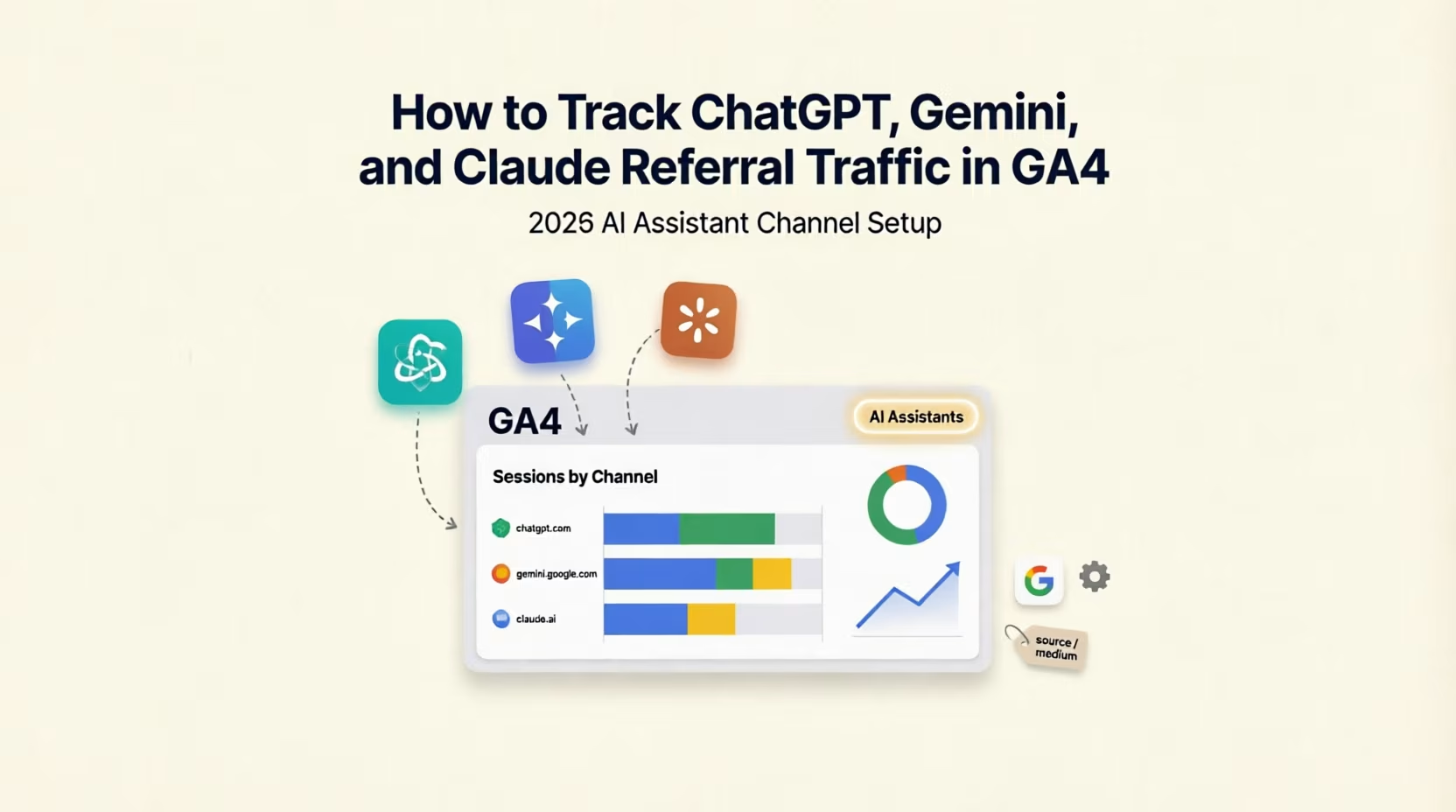 How to Track ChatGPT, Gemini, and Claude Referral Traffic in GA4 (2026 AI Assistant Channel Setup)
-
 Microsoft Clarity + Claude AI for CRO in Dubai: MCP Setup Guide 2026
-
 The 90-Day Growth System: A Digital Marketing Strategy Dubai Businesses Can Actually Run
Want this done for your business? See my Search Engine Marketing services in Dubai.
Latest Posts
-
 How to Set Up TikTok Shop in the UAE: A Step-by-Step 2026 Seller Guide
-
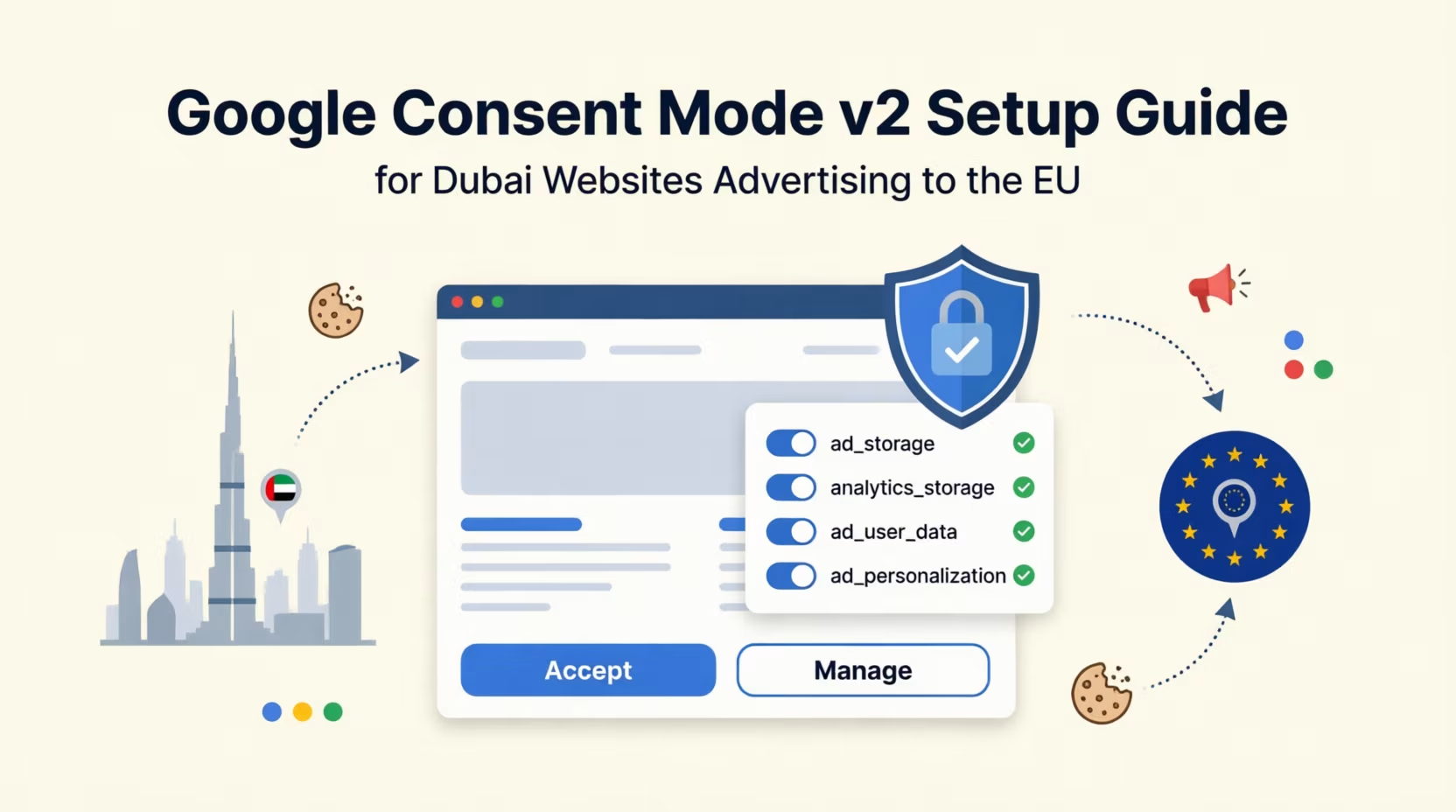 Google Consent Mode v2 Setup Guide for Dubai Websites Advertising to the EU
-
How to Track ChatGPT, Gemini, and Claude Referral Traffic in GA4 (2026 AI Assistant Channel Setup)
-
 Two Critical WordPress Vulnerabilities Patched in August 2026 — Update Your Dubai Site Now
-
UAE PDPL Compliance for Marketers: What Your Tracking Pixels Actually Need in 2026
-
 Performance Max in 2026: Asset Experiments, New Audience Exclusions, and What Actually Changed
-
 Should You Let an AI Agent Run Your Ad Campaigns? A Dubai Marketer's Honest Take
-
 AI Overviews vs AI Mode: What Changed in Google Search in 2026 (And What Dubai Businesses Should Do About It)
-
 Google Ads Is Removing Language Targeting From Search in September 2026 & What It Means for Your EN/AR Campaigns
-
 Google Says GEO Isn't a Separate Strategy From SEO— What That Actually Means for Dubai Businesses
Get a Growth Plan, Not Just a Quote
Seeking expert digital marketing, web design, or graphic design in the UAE? Let's discuss your project and deliver tailored solutions for measurable growth.
Book Free Consultation