
From 83,000 Conversions to AED 0.95 CPL: The Google Ads Playbook Behind the Ezee Hire Case Study

Most recruitment agencies in Dubai have run Google Ads at some point. Fewer have run them well. The category has a structural problem that generic PPC advice never addresses: the same core terms — “maid,” “nanny,” “housemaid,” “domestic worker” — get searched by two completely different audiences with opposite intent. One is a household in Dubai or Abu Dhabi looking to hire. The other is a job seeker looking for work. Feed both into the same campaign with broad match and no negative-keyword discipline, and you are paying premium UAE CPCs to attract people who will never become a paying client.
That mismatch is the single biggest reason recruitment-agency Google Ads accounts in the UAE bleed budget. It is also the first thing we rebuilt when we took over paid search for Ezee Hire, a domestic-worker recruitment agency operating across Dubai, Abu Dhabi, and Sharjah. The account went on to generate more than 83,000 tracked conversions, with the campaign’s lowest cost-per-lead landing at AED 0.95 — a number that is easy to state and much harder to explain unless you understand what had to happen operationally to get there.
This post is that explanation. We are publishing it as a companion to our full Ezee Hire Google Ads case study, which covers the campaign timeline and results in detail. Here, we are breaking down the account architecture, the negative-keyword logic, the cross-channel conversion tracking, and the day-to-day discipline that any recruitment agency running Google Ads in the UAE needs in order to get comparable numbers.
Why Recruitment-Agency Google Ads Accounts Fail in the UAE
Set up a single campaign around “hire a maid in Dubai” using broad or phrase match without a serious negative-keyword list, and within days you will be paying for clicks from people searching “maid jobs in Dubai,” “housemaid vacancy Dubai,” and “how to become a nanny in UAE.” Google’s auction does not know the difference between an employer’s intent and a jobseeker’s intent — the words overlap almost entirely. Only your account structure and keyword logic can separate them.
The second failure mode is language. A large share of UAE search volume for household staffing happens in Arabic, and treating Arabic as an afterthought — a few translated headlines bolted onto an English campaign — consistently under-performs. Bilingual EN/AR execution needs to be a structural decision made at the campaign level, not a copywriting patch applied at the ad level.
The third failure mode is measurement. Recruitment and domestic-staffing inquiries in the UAE rarely convert cleanly through a single channel. A prospective client might fill a form, then call to confirm details, then message on WhatsApp to finalize. If your conversion tracking only counts form fills, you are underreporting real demand and optimizing your bidding algorithm against incomplete data — which quietly pushes Smart Bidding in the wrong direction.
The Account Structure That Actually Works
For Ezee Hire, the account was rebuilt around a structure closer to SKAG/STAG discipline (single keyword ad groups / single theme ad groups) than the loosely grouped, broad-match campaigns typical of in-house recruitment-agency accounts. Three structural decisions mattered most:
1. Campaigns split by service line, not by geography first. Live-in maid placement, part-time cleaning services, nanny placement, and cook/driver placement each have different search volume, different commercial intent, and different acceptable cost-per-lead thresholds. Bundling them into one campaign forces a single bid strategy onto demand that behaves very differently, which is a common reason recruitment-agency accounts plateau.
2. Separate campaigns for English and Arabic, not shared ad groups with translated assets. Bilingual EN/AR campaigns were built as distinct campaigns with their own keyword sets, ad copy, and landing page variants, so that Arabic-language search behavior could be optimized on its own terms rather than inheriting English-campaign settings by default. This also makes it possible to see, at a glance, which language is driving cheaper, higher-quality leads in which emirate — useful when allocating budget across Dubai, Abu Dhabi, and Sharjah.
3. Tightly themed ad groups mapped to landing pages. Each ad group targets a narrow keyword theme with an ad and landing page written for that specific intent — “live-in maid Dubai” sends traffic to a page about live-in placement, not a generic homepage. This is standard PPC hygiene, but it is the part most recruitment agencies skip under time pressure, and it is a major lever behind quality score and, downstream, cost-per-lead.
Negative-Keyword Discipline: The Job-Seeker vs. Employer Split
This is the part of recruitment-agency PPC that generic e-commerce or SaaS playbooks never cover, because the problem does not exist in those categories. In domestic-staffing search, job-seeker intent and employer intent share almost the exact same vocabulary, and separating them is not optional — it is the difference between a usable account and a wasted one.
The negative-keyword list built for the employer-intent campaigns excluded terms carrying job-seeker signals: “jobs,” “vacancy,” “vacancies,” “hiring near me” (in a jobseeker context), “salary,” “how to apply,” “CV,” “visa sponsorship for,” and their Arabic equivalents. Search term reports were reviewed on a recurring basis specifically to catch new job-seeker-intent queries slipping through as language and slang evolved, and each new pattern was added to the shared negative list across every employer-intent campaign rather than patched one ad group at a time.
Running the inverse is just as important if an agency also advertises for candidate recruitment: a job-seeker-facing campaign needs its own negative list excluding employer-intent terms like “hire,” “agency fees,” and “book a maid,” so the two audiences never cross-contaminate each other’s campaigns or dilute each other’s conversion data.
Conversion Tracking Across Form, Call, and WhatsApp
Smart Bidding is only as good as the conversion signal feeding it. For a recruitment agency, that signal is fragmented by default: some prospects fill a contact form, some call directly from the ad’s call extension or the landing page’s click-to-call button, and a growing share message the business on WhatsApp because it is the lower-friction option for a UAE audience already living inside the app.
Getting an accurate picture required stitching all three into Google Ads as trackable conversion actions: form submissions tracked through Google Tag Manager, call conversions tracked through Google’s call-tracking number swap on both ads and landing pages, and WhatsApp click events tracked as a distinct conversion action fired when a visitor tapped the WhatsApp CTA. Without the WhatsApp leg specifically, a meaningful share of real, sales-qualified demand simply never reaches the algorithm, and Smart Bidding ends up under-valuing the keywords and audiences that actually drive WhatsApp engagement — which, for this category, are often the strongest performers.
Once all three channels were feeding conversion data back into the account, bid strategies could be trusted to optimize toward genuine lead volume rather than just the easiest-to-measure channel. That single change — closing the WhatsApp tracking gap — is one of the most common fixes we make when auditing recruitment and services accounts in the UAE, and it is worth checking first if your own account’s conversion numbers look implausibly low relative to your actual enquiry volume.
What “Lowest CPL” Actually Required Operationally
AED 0.95 as a cost-per-lead figure is the kind of number that gets shared without context, so it is worth being precise: it represents the lowest cost-per-lead achieved across the campaign’s active period, not a flat average from day one. Getting there was a function of several things compounding over time rather than one single tactic:
Search-term hygiene as a weekly habit, not a launch-week task. New job-seeker-intent queries and irrelevant broad-match expansions were caught and excluded on an ongoing basis, which kept wasted spend from creeping back in as Google’s auto-applied recommendations and broad-match expansion continued to widen reach over time.
Landing page and ad message alignment. Ad groups mapped tightly to landing pages meant Quality Score stayed high, which directly lowers cost-per-click in Google’s auction — a compounding advantage that shows up as cheaper leads month over month even at a stable bid strategy.
Full-funnel conversion data feeding Smart Bidding. With form, call, and WhatsApp conversions all counted, the bidding algorithm had a genuinely complete picture of what “a lead” looked like, which let it bid more aggressively on the keyword and audience combinations that were actually converting — instead of chasing the narrower, partial signal most recruitment-agency accounts feed it.
Bilingual budget reallocation based on performance, not assumption. Because English and Arabic ran as separate campaigns, budget could shift toward whichever language and emirate combination was producing cheaper, higher-intent leads at any given point, rather than splitting spend evenly by default.
The Results, By the Numbers
Across the campaign’s active period, the Ezee Hire Google Ads account generated more than 83,000 tracked conversions across bilingual EN/AR campaigns, with cost-per-lead reaching a low of AED 0.95 at its most efficient point. That result came from the structural work above — account architecture split by service line and language, disciplined negative-keyword management specific to the job-seeker/employer split, cross-channel conversion tracking that included WhatsApp, and continuous optimization rather than a set-and-forget campaign launch.
The full breakdown of the campaign, including how it evolved over time, lives in our Ezee Hire Google Ads case study. If your agency runs staffing, recruitment, or any category where two very different audiences search the same keywords, the same structural principles apply directly to your account.
If you want this rebuilt for your own Google Ads account, our Google Ads and PPC management service for the UAE covers the same account architecture, bilingual campaign build, negative-keyword systems, and cross-channel conversion tracking described above.
Frequently Asked Questions
Book a free Google Ads audit at as86.pro or WhatsApp us directly on +971 52 130 0516 — bilingual service available in English and Arabic across Dubai, Abu Dhabi, Sharjah, and the wider UAE.

Written by Amir Sibaee
Google Ads & Media Buying Specialist · SEO/SEM · Marketing Automation ·...
More about Amir →Related Reading
-
 Google Ads AI Max Takeover: What Dubai Advertisers Must Do Before Dynamic Search Ads Disappear in September 2026
-
 PPC Management in Abu Dhabi: What's Actually Different From Dubai (And Why Most Agencies Get It Wrong)
-
 RSA Search Term Categories Dubai 2026: Cut Wasted PPC Spend in UAE
-
 How to Track WhatsApp Leads in Google Ads: GTM & Zapier Setup for Dubai (2026)
Want this done for your business? See my Search Engine Marketing services in Dubai.
Latest Posts
-
 How to Set Up TikTok Shop in the UAE: A Step-by-Step 2026 Seller Guide
-
 Google Consent Mode v2 Setup Guide for Dubai Websites Advertising to the EU
-
 How to Track ChatGPT, Gemini, and Claude Referral Traffic in GA4 (2026 AI Assistant Channel Setup)
-
 Two Critical WordPress Vulnerabilities Patched in August 2026 — Update Your Dubai Site Now
-
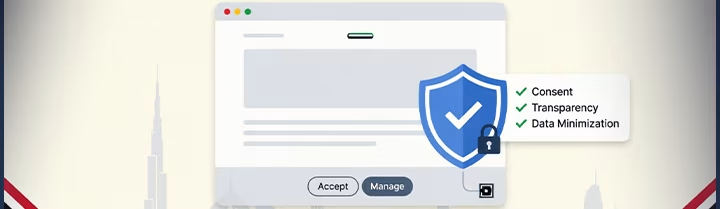 UAE PDPL Compliance for Marketers: What Your Tracking Pixels Actually Need in 2026
-
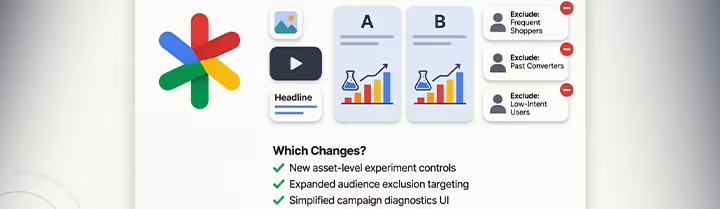 Performance Max in 2026: Asset Experiments, New Audience Exclusions, and What Actually Changed
-
 Should You Let an AI Agent Run Your Ad Campaigns? A Dubai Marketer's Honest Take
-
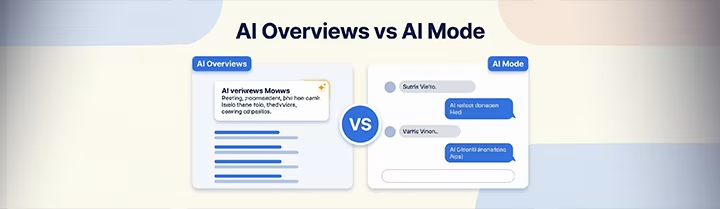 AI Overviews vs AI Mode: What Changed in Google Search in 2026 (And What Dubai Businesses Should Do About It)
-
 Google Ads Is Removing Language Targeting From Search in September 2026 & What It Means for Your EN/AR Campaigns
-
 Google Says GEO Isn't a Separate Strategy From SEO— What That Actually Means for Dubai Businesses
Get a Growth Plan, Not Just a Quote
Seeking expert digital marketing, web design, or graphic design in the UAE? Let's discuss your project and deliver tailored solutions for measurable growth.
Book Free Consultation