
SKAG vs STAG: Which Google Ads Strategy Wins in Dubai 2026?
SKAGs or STAGs? In 2026 the answer depends on three measurable factors — your budget, your conversion volume, and how mature your smart bidding is. Here's the decision framework Dubai advertisers actually need, plus the hybrid setup that wins most UAE accounts.
So Which Google Ads Strategy Delivers Better ROI in 2026?
Running Google Ads in 2026 is a bit like driving Sheikh Zayed Road at rush hour: you can reach your destination, but how you navigate matters enormously. Two of the most debated campaign structures in PPC — SKAGs (Single Keyword Ad Groups) and STAGs (Single Theme Ad Groups) — sit at the centre of that navigation debate. Both deliver results. The real question is which one delivers better ROI for your specific account, budget, and market conditions in the UAE.
The short answer is that neither structure wins universally. The longer answer — the one that actually helps you build campaigns that perform — is a decision framework based on three variables you can measure right now. That's what this guide covers.
What Exactly Are SKAGs?
Think of SKAGs as the perfectionists of PPC. Each ad group revolves around one keyword only, giving you maximum control over which searches trigger which ads.
✅ Higher CTRs — because your ad copy matches search intent precisely ✅ Improved Quality Scores — leading to cheaper clicks over time ✅ Granular reporting — every keyword has its own performance data
The trade-off is management overhead. SKAGs multiply ad groups quickly, which means more to monitor, more to optimise, and more to break when Google changes something upstream.
Where SKAGs Struggle in 2026
Close variant expansion means "exact match" keywords now match searches Google considers similar — cousins you didn't invite into the ad group. This dilutes the precision that made SKAGs valuable in the first place.
Data fragmentation is the deeper problem. Too many ad groups means too few conversions per group, which starves Google's smart bidding of the learning data it needs. An ad group seeing three conversions a month cannot train a tCPA algorithm effectively.
Management load scales brutally. An account with 200 SKAGs requires 200 times the monitoring, 200 times the negative keyword hygiene, and 200 times the copy refresh cycle.
Verdict: SKAGs still work powerfully for high-intent, high-value keywords — branded terms, your most competitive service keywords, specific location-plus-service combinations like "dental clinic DIFC". They are no longer a scalable foundation for an entire account.
Enter STAGs: Built for Google's Automation Era
STAGs organise keyword clusters around one shared intent rather than one keyword. Instead of a separate ad group for every variation, you group three to ten related terms that a single set of ad copy can serve well.
Example for a Dubai cleaning service:
- "home cleaning dubai"
- "apartment cleaning service dubai"
- "residential cleaning dubai"
- "house cleaning near me dubai"
These share the same searcher intent — someone who wants their home cleaned in Dubai. One well-written RSA can serve all four better than four separate ad groups with nearly identical copy.
Why STAGs Work Better in 2026
Consolidated data means Google's algorithm sees more conversions per ad group, enabling smart bidding to learn faster and optimise more accurately. A STAG seeing 30 conversions a month trains a tCPA bid strategy. A SKAG seeing 3 conversions a month does not.
Lower management overhead means your time goes toward strategy and creative rather than endless ad group maintenance.
Better machine learning alignment — Google's systems are built around intent signals, not exact keyword strings. STAGs mirror the way the platform actually works in 2026.
Verdict: STAGs align with how Google's automation functions today and are the right default structure for most Dubai campaigns running smart bidding with moderate to healthy conversion volume.
SKAG vs STAG: The Head-to-Head
| Aspect | SKAG | STAG |
|---|---|---|
| Keywords per group | 1 | 3–10 |
| Ad relevance | Very high | High |
| CTR potential | Highest | Moderate–high |
| Setup complexity | High | Low–medium |
| Smart bidding fit | Low | High |
| Minimum conversions needed | 10+/month per group | 20–30+/month per group |
| Best for | Manual control, branded terms | Automated bidding, scaling |
| Management overhead | Heavy | Light–medium |
The Decision Framework: Which Structure Is Right for Your UAE Account?
This is the question the comparison table can't answer on its own. Here's the framework based on three measurable variables.
Variable 1 — Monthly budget per campaign
If your campaign budget is under AED 5,000 per month, STAGs are almost always the better choice. At constrained budgets, data consolidation matters more than keyword-level precision — you need every conversion signal going to as few ad groups as possible so smart bidding can actually learn. SKAGs at low budgets produce ad groups with one or two conversions per month, which is not enough for any automation to function meaningfully.
If your budget exceeds AED 15,000 per month per campaign, you have enough volume to consider a hybrid — SKAGs for your top 10–15 highest-value keywords and STAGs for everything else.
Variable 2 — Monthly conversion volume
Under 30 conversions per month across the account: consolidate into STAGs immediately. Smart bidding needs a minimum of 30–50 conversions per month in a campaign to exit the learning phase. Fragmented SKAGs make this impossible at modest volumes.
Over 50 conversions per month with stable CPA trends: you have the data density to test SKAGs on your highest-intent terms without starving the algorithm.
Variable 3 — Smart bidding maturity
If you are running manual CPC or enhanced CPC: SKAGs give you the control that manual bidding rewards — you can adjust bids at the keyword level precisely.
If you are running tCPA or tROAS: STAGs are strongly preferable. Automated bid strategies need consolidated conversion signals. Splitting them across dozens of SKAGs actively degrades performance.
The Hybrid Setup That Wins Most Dubai Accounts
The practical answer for most UAE accounts running in 2026 is neither pure SKAG nor pure STAG — it's a deliberate hybrid.
Tier 1 — SKAGs for your 10–15 money keywords. These are your highest-intent, highest-value terms: your brand name, your primary service plus location (e.g. "SEO consultant Dubai", "dental clinic Business Bay"), and any keyword that individually drives enough conversions to justify its own ad group. Pin your best RSA copy, monitor closely, and use manual or enhanced CPC.
Tier 2 — STAGs for themed keyword clusters. Group everything else by intent theme. "Home cleaning Dubai" variations in one group. "Deep cleaning Dubai" variations in another. "Office cleaning Dubai" in a third. Run smart bidding here and let Google's automation work with consolidated data.
Tier 3 — One broad discovery group per theme. A single broad match ad group per major theme, tightly controlled with exact negatives, to capture search terms you haven't thought of yet. Treat it as a keyword research engine — mine it weekly and promote winners to Tier 1 or Tier 2.
This three-tier structure gives you precision where precision pays off, automation where automation excels, and discovery where you need growth.
What Does a Google Ads Specialist Actually Do Differently in the UAE?
This is worth addressing directly, because it explains why the same SKAG vs STAG debate produces different outcomes across different accounts in Dubai.
A specialist managing Google Ads in the UAE isn't just choosing between two structural frameworks — they're making a sequence of interconnected decisions that compound over time. Match type selection in a bilingual market (English and Arabic keywords behave differently under broad match expansion). Negative keyword hygiene specific to Dubai search patterns (job seekers, students, and tourism queries pollute UAE campaigns in ways that don't apply in Western markets). Conversion tracking that captures WhatsApp initiations, not just form submissions. Bid adjustments weighted toward the districts where your best clients cluster — Business Bay, JLT, Marina, DIFC — rather than applying a flat Dubai-wide bid.
The SKAG vs STAG decision is one input. The specialist's value comes from getting every other input right around it — and adjusting the structure as the account matures, the budget scales, and the data accumulates.
Case Study: Dubai Manpower Agency
One manpower agency in Dubai was running scattered ad groups with no coherent structure — a mix of abandoned SKAGs and overlapping broad match groups, with smart bidding running on fragmented conversion data.
After restructuring into a hybrid — SKAGs for branded terms and their top three service keywords, STAGs for all remaining intent clusters — CTR moved from 2.5% to 7.1% within 40 days. CPC dropped by 29%. More importantly, the tCPA algorithm had enough consolidated conversion data to exit the learning phase within two weeks of the restructure, something it had never managed under the fragmented setup.
The lesson isn't that STAGs are magic. It's that structural alignment with how Google's automation actually works produces compounding performance improvements that keyword-level tweaks never will.
Should You Switch Right Now?
If your current account has more than 50 active ad groups and fewer than 50 conversions per month, restructuring toward STAGs is likely your highest-leverage optimisation. Before making any changes, follow this sequence.
First, export your current search term report and identify which queries are actually converting. You may find that 80% of your conversions come from 15–20 search terms — those are your SKAG candidates. Everything else belongs in a STAG cluster.
Second, build the new structure in a draft campaign or a separate campaign before pausing the existing one. Never restructure a live converting campaign without a parallel test running.
Third, give the new structure a minimum of four weeks and 30+ conversions before evaluating performance. Smart bidding needs time to learn the new consolidation. Week-one data is noise.
Frequently Asked Questions
Ready to Restructure Your Google Ads Account?
The right structure for your UAE account depends on your budget, your conversion volume, and how your smart bidding is currently performing. If you'd like a specialist to audit your current setup and recommend the exact restructure that makes sense for your specific account — including which keywords deserve SKAG treatment and which should be consolidated into STAGs — a free strategy session is the fastest way to get there.
Book your free Google Ads consultation at as86.pro — bilingual service available in English and Arabic across all UAE markets.
Related reading:

Written by Amir Sibaee
Google Ads & Media Buying Specialist · SEO/SEM · Marketing Automation ·...
More about Amir →Related Reading
-
 How to Write Google Ads That Convert in Dubai: 2026 Copywriting Playbook
-
 Microsoft Ads Website Exclusion Guide for Dubai Advertisers (2026)
-
 From 83,000 Conversions to AED 0.95 CPL: The Google Ads Playbook Behind the Ezee Hire Case Study
-
 RSA Search Term Categories Dubai 2026: Cut Wasted PPC Spend in UAE
Want this done for your business? See my Search Engine Marketing services in Dubai.
Latest Posts
-
 How to Set Up TikTok Shop in the UAE: A Step-by-Step 2026 Seller Guide
-
 Google Consent Mode v2 Setup Guide for Dubai Websites Advertising to the EU
-
 How to Track ChatGPT, Gemini, and Claude Referral Traffic in GA4 (2026 AI Assistant Channel Setup)
-
 Two Critical WordPress Vulnerabilities Patched in August 2026 — Update Your Dubai Site Now
-
 UAE PDPL Compliance for Marketers: What Your Tracking Pixels Actually Need in 2026
-
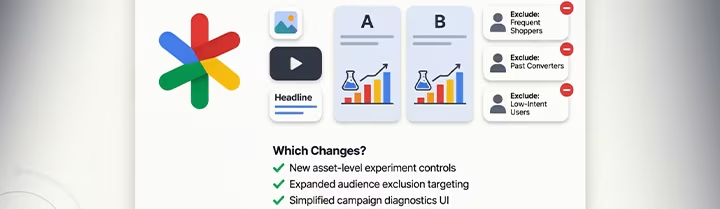 Performance Max in 2026: Asset Experiments, New Audience Exclusions, and What Actually Changed
-
 Should You Let an AI Agent Run Your Ad Campaigns? A Dubai Marketer's Honest Take
-
 AI Overviews vs AI Mode: What Changed in Google Search in 2026 (And What Dubai Businesses Should Do About It)
-
 Google Ads Is Removing Language Targeting From Search in September 2026 & What It Means for Your EN/AR Campaigns
-
 Google Says GEO Isn't a Separate Strategy From SEO— What That Actually Means for Dubai Businesses
Get a Growth Plan, Not Just a Quote
Seeking expert digital marketing, web design, or graphic design in the UAE? Let's discuss your project and deliver tailored solutions for measurable growth.
Book Free Consultation