
EN & AR in Google Ads: Separate Campaigns vs Ad Groups—and Broad vs Phrase Match (Dubai, 2026)

Running Google Ads in a bilingual Dubai market isn't just a translation exercise — it's a structural decision that directly affects Quality Score, match type behaviour, and conversion rates. Here's the 2026 framework for getting EN and AR campaigns right.
EN & AR in Google Ads: Separate Campaigns vs Ad Groups — The Dubai Bilingual PPC Guide 2026
Dubai is one of the few markets in the world where a single business routinely needs to run Google Ads in two completely different languages — and where getting that structure wrong silently drains budget every day without triggering a single alert in your account.
The decision sounds simple: should your English and Arabic keywords live in the same campaign, the same ad group, or be separated entirely? The answer has meaningful consequences for your Quality Score, your match type behaviour, your RSA relevance, and ultimately your cost-per-lead. This guide lays out the full framework, updated for 2026's smart bidding environment, so you can make the right structural call for your specific account.
Why Bilingual Structure Matters More Than Most Advertisers Realise
Most Dubai advertisers treat the EN/AR question as an afterthought — they add a few Arabic keywords to an existing English campaign and call it bilingual. This approach has three compounding problems that compound each other over time.
Quality Score degrades. Google calculates Quality Score at the keyword level, weighing expected CTR, ad relevance, and landing page experience. When Arabic keywords are mixed into an English ad group, the Arabic keyword triggers an English RSA — and the mismatch between the search query language and the ad copy language suppresses expected CTR. Lower CTR means lower Quality Score. Lower Quality Score means higher CPC. You pay more for every Arabic click than you should.
Match type expansion becomes unpredictable. Phrase and broad match keywords in Arabic expand into Arabic search queries that Google considers semantically related. When these sit in the same ad group as English keywords, the smart bidding algorithm receives mixed signals about which language context this ad group is optimised for. This creates erratic impression share behaviour — often at the cost of your Arabic keywords, which tend to have lower individual search volumes and lose out to the English keywords in the same group.
Landing page experience suffers. A user searching in Arabic and landing on an English page faces an immediate trust gap — particularly in service categories like healthcare, legal, and home services where language is a proxy for understanding the client's needs. Google measures this through engagement signals (bounce rate, time on page, return visits) and feeds it back into Quality Score. The structural problem upstream creates a conversion problem downstream.
The Core Structural Decision
There are three ways to organise bilingual campaigns in Google Ads. Each has legitimate use cases, and each has failure modes. Here's the complete picture.
Option 1: Separate Campaigns per Language
Structure: One campaign for all English keywords and targeting, one campaign for all Arabic keywords and targeting. Separate budgets, separate bidding, separate RSAs, separate landing pages.
When it's right:
- Your Arabic and English audiences have meaningfully different conversion patterns or CPL targets
- You have sufficient budget to fund both campaigns independently (typically AED 3,000+ per campaign per month)
- Your landing pages exist in both languages with genuine localisation, not just translation
- You want clean, separate reporting on Arabic vs English performance without any data blending
When it fails:
- Budget is constrained — splitting a AED 5,000 budget into two AED 2,500 campaigns starves both of conversion data
- Your Arabic landing page is a translation rather than a localisation — users notice, and bounce rates reflect it
- Management overhead doubles with no proportional performance benefit at low volume
Option 2: Separate Ad Groups per Language (Same Campaign)
Structure: One campaign with shared budget and bidding, but dedicated ad groups for English keywords and dedicated ad groups for Arabic keywords. Each language gets its own RSAs, sitelinks, and callouts.
When it's right:
- Budget is moderate (AED 3,000–8,000/month) and consolidation is more important than granular language-level control
- Your conversion goals and target CPA are the same for both language audiences
- You want smart bidding to work across the full campaign budget without language-based fragmentation
When it fails:
- You need separate budget caps per language (not possible within the same campaign)
- Arabic keywords are dramatically lower volume — smart bidding deprioritises them in favour of higher-volume English keywords within the same campaign
Option 3: Mixed Keywords, Single Ad Group
Structure: English and Arabic keywords in the same ad group, served by the same RSAs.
When it's right: Almost never for a serious campaign. This structure is only defensible as a testing phase — a brief diagnostic period to identify which Arabic terms are generating impressions before building out proper structure.
When it fails: Everywhere else. Mixed-language ad groups consistently produce lower Quality Scores, worse RSA performance, and muddier conversion data than either of the structured alternatives above.
Decision Table
| Scenario | Recommended structure | Reason |
|---|---|---|
| Budget under AED 5,000/month | Separate ad groups, one campaign | Consolidates data for smart bidding; avoids starving either language |
| Budget AED 5,000–15,000/month | Separate ad groups OR separate campaigns | Either works — choose based on whether CPL targets differ by language |
| Budget over AED 15,000/month | Separate campaigns | Sufficient budget to fund independent learning and separate optimisation |
| Different CPL targets per language | Separate campaigns always | Same campaign cannot apply different tCPA targets per language |
| Same CPL target, similar conversion volume | Separate ad groups, one campaign | Simplicity wins; smart bidding works better with consolidated data |
| Launching Arabic for first time | Start with ad groups, promote to separate campaign if volume justifies | Avoids committing budget before validating Arabic demand in your category |
| Arabic landing page = translated only | Fix the page before separating campaigns | Structural separation cannot compensate for a trust-gap landing page |
Match Type Behaviour in Bilingual Campaigns: The Hidden Complication
This is where even experienced Dubai PPC managers get caught off guard. Arabic and English match type expansion behaves differently — and the difference has practical consequences for both keyword coverage and wasted spend.
Broad match in Arabic expands more aggressively into colloquial and dialectal variations than English broad match does. Modern Standard Arabic keywords routinely trigger Gulf dialect searches, Egyptian dialect searches, and Levantine dialect searches — which may or may not represent your target audience in the UAE. A cleaning company targeting UAE residents might see Broad Match Arabic keywords triggering searches from users in other GCC countries if geo-targeting isn't set precisely.
Phrase match in Arabic is generally more reliable as a starting point — it captures intent while limiting expansion to queries that contain your core phrase in the correct semantic order. For most Dubai campaigns launching Arabic for the first time, phrase match is the safer entry point.
Exact match in Arabic is more restrictive than it was pre-2019, but still the most controlled option for high-value, high-CPC Arabic keywords. For terms like تنظيف منازل دبي (home cleaning Dubai) in a competitive category, exact match preserves bid control at the keyword level.
Practical rule for UAE bilingual campaigns: Start Arabic keywords on phrase match. Add exact match for your top 5 highest-intent terms from day one. Move to broad match only after 60 days of search term data — and only with a robust negative keyword list in both languages already in place.
RSA Copy Structure for Bilingual Campaigns
The copy principles that apply to English RSAs also apply to Arabic RSAs — with one additional constraint. Arabic RSAs must be written natively, not translated. This distinction matters more than it sounds.
A translated Arabic RSA takes English copy and converts it word-for-word. The result is grammatically correct Arabic that sounds like it was written by someone who doesn't speak Arabic as their primary language. Native-written Arabic copy uses the register, idioms, and directness patterns that Arabic speakers expect — which directly impacts CTR.
In practical terms for Dubai campaigns: English RSAs typically perform better with efficiency signals (same-day service, AED pricing, online booking). Arabic RSAs typically respond better to trust signals (established business, local presence, Arabic-speaking team) alongside the offer. These differences aren't universal, but they're consistent enough across UAE campaigns that they're worth building into your initial copy hypotheses.
Do not mix languages within a single RSA. Not even for a CTA. An Arabic RSA with an English CTA like "Book Now" creates a code-switching moment that reads as unprofessional to a native Arabic speaker. If your CTA is the button on the landing page, your RSA CTA should match the language of the ad.
The 4-Week Bilingual Campaign Rollout Plan
If you're building or restructuring a bilingual campaign from scratch, this sequence minimises risk while generating the data you need to make confident structural decisions.
Week 1 — English foundation: Launch English campaign with exact and phrase match. Set conversion tracking for all actions (form, call, WhatsApp). Establish baseline CPL before introducing Arabic variables.
Week 2 — Arabic ad groups (same campaign): Add Arabic ad groups to the same campaign. Native-written RSAs. Phrase match only. Same landing page in Arabic. Monitor search term reports daily for unexpected expansion.
Week 3 — Negative keyword cross-pollination: Build English negatives from Arabic search terms triggering in English ad groups, and vice versa. This is the maintenance step most advertisers skip — and skipping it is why bilingual campaigns develop expensive cross-language bleeding.
Week 4 — Evaluation: Review CPL, CTR, and conversion rate by language. If Arabic CPL is significantly higher or lower than English, consider separating into distinct campaigns with independent tCPA targets. If performance is comparable, keep consolidated and increase budget.
What a Google Ads Specialist Does Differently in the UAE Bilingual Context
Managing bilingual Google Ads in Dubai isn't just campaign architecture — it's a sustained set of decisions that most automated tools can't make for you.
A specialist managing UAE bilingual campaigns is making ongoing calls about when to promote Arabic ad groups to their own campaign (based on conversion volume thresholds, not arbitrary timelines), how to build negative keyword lists that work across two languages and multiple Arabic dialects, which match types to use at each stage of campaign maturity, and how to write RSA copy that's genuinely native in Arabic rather than translated from English. These decisions compound over months. The accounts that perform best in Dubai's bilingual PPC environment aren't the ones with the biggest budgets — they're the ones where someone made the right structural calls early and maintained discipline in both languages as the account scaled.
Frequently Asked Questions
Ready to Build a Bilingual Google Ads Strategy That Actually Works?
Bilingual PPC in Dubai rewards precision. The structural decisions you make in weeks one and two compound — in either direction — for as long as the campaign runs. Getting the EN/AR architecture right from the start isn't optional in a market where Arabic speakers represent a significant portion of high-intent buyers in almost every service category.
If you'd like a specialist to audit your current bilingual campaign structure — or build one from scratch that's engineered for the UAE market in both languages — a free strategy session is the fastest way to identify exactly where your current setup is leaking budget.
Book your free Google Ads consultation at as86.pro — native Arabic and English service across all UAE markets.
Related reading:

Written by Amir Sibaee
Google Ads & Media Buying Specialist · SEO/SEM · Marketing Automation ·...
More about Amir →Related Reading


Want this done for your business? See my Search Engine Marketing services in Dubai.
Latest Posts
-
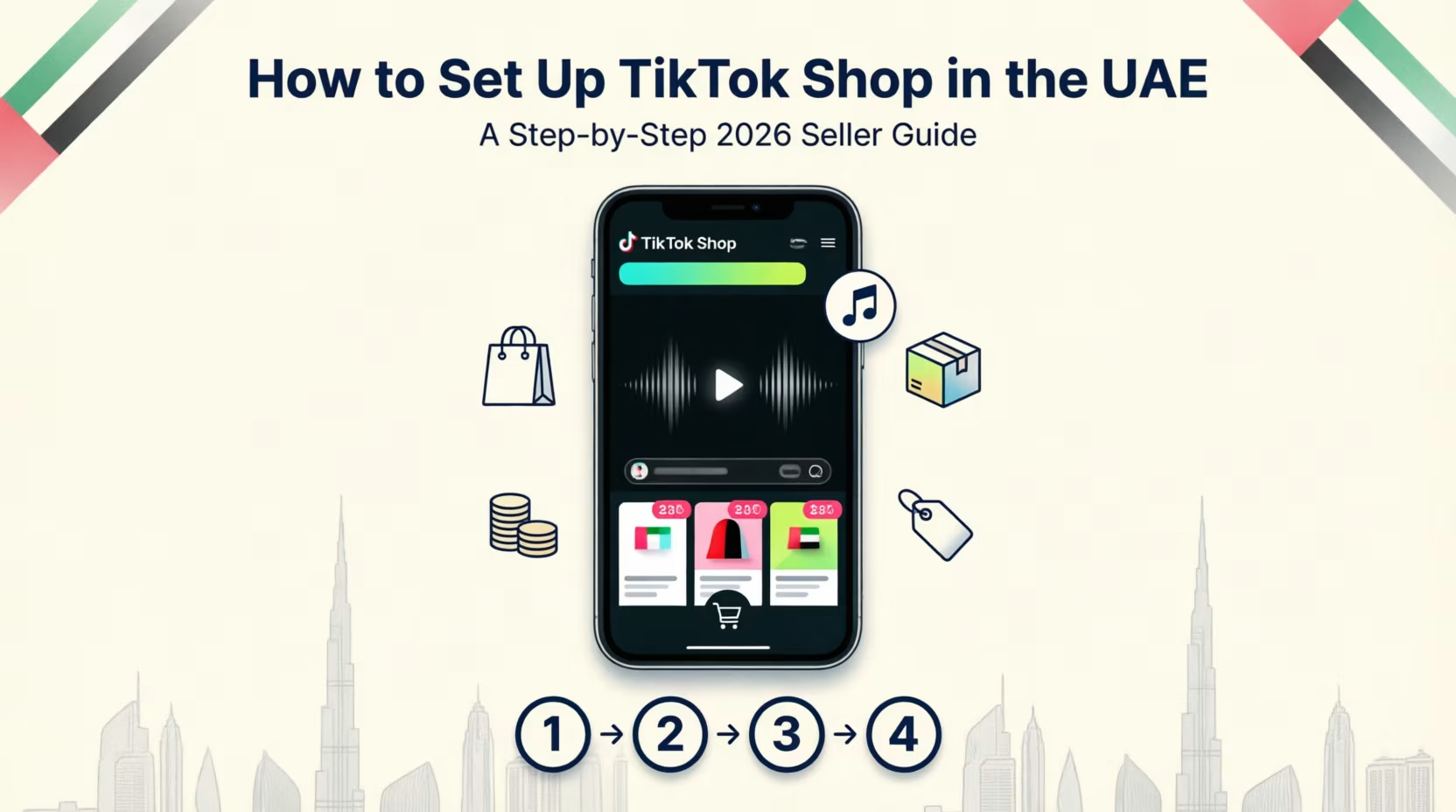 How to Set Up TikTok Shop in the UAE: A Step-by-Step 2026 Seller Guide
-
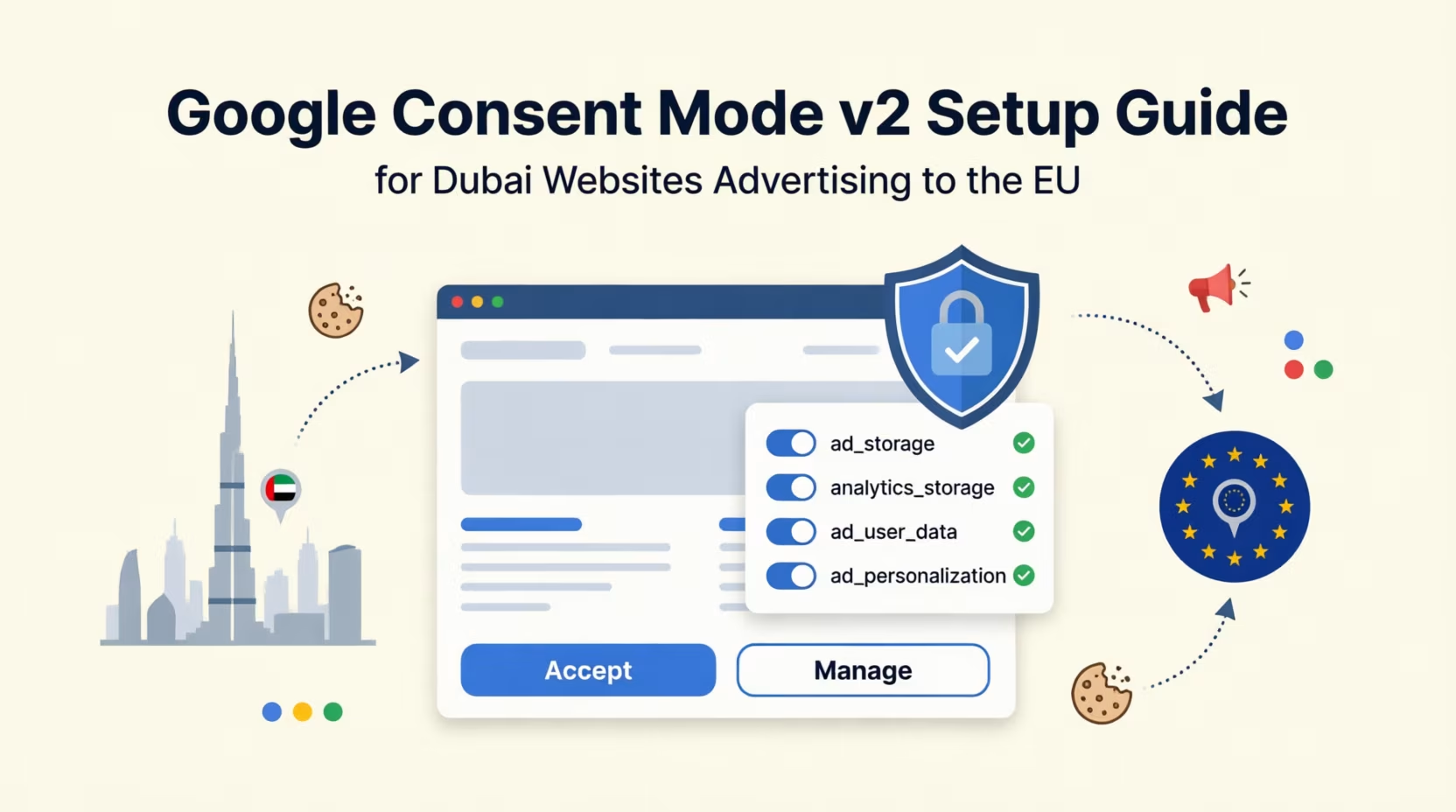 Google Consent Mode v2 Setup Guide for Dubai Websites Advertising to the EU
-
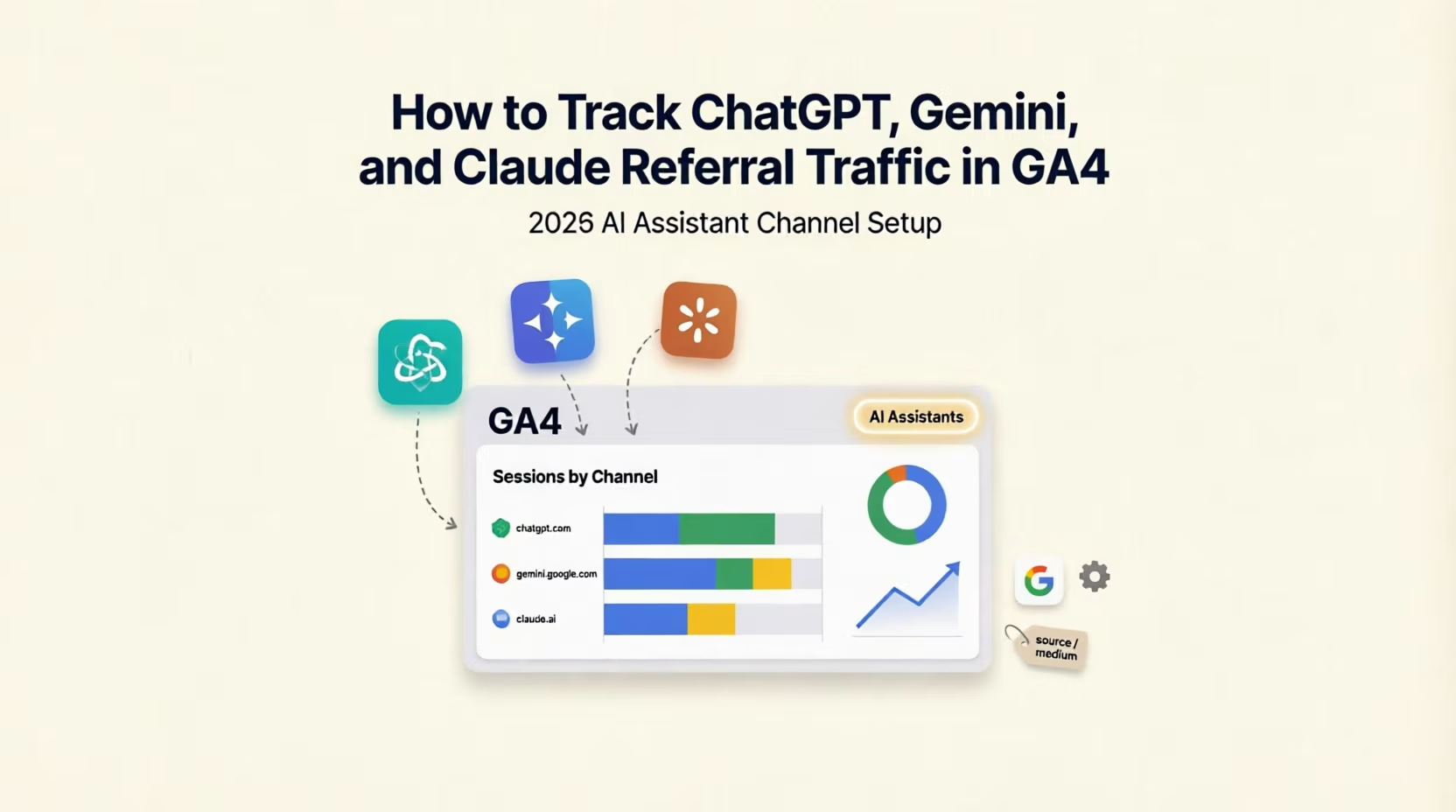 How to Track ChatGPT, Gemini, and Claude Referral Traffic in GA4 (2026 AI Assistant Channel Setup)
-
 Two Critical WordPress Vulnerabilities Patched in August 2026 — Update Your Dubai Site Now
-
 UAE PDPL Compliance for Marketers: What Your Tracking Pixels Actually Need in 2026
-
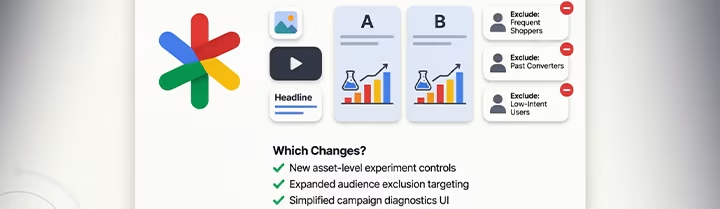 Performance Max in 2026: Asset Experiments, New Audience Exclusions, and What Actually Changed
-
 Should You Let an AI Agent Run Your Ad Campaigns? A Dubai Marketer's Honest Take
-
 AI Overviews vs AI Mode: What Changed in Google Search in 2026 (And What Dubai Businesses Should Do About It)
-
 Google Ads Is Removing Language Targeting From Search in September 2026 & What It Means for Your EN/AR Campaigns
-
 Google Says GEO Isn't a Separate Strategy From SEO— What That Actually Means for Dubai Businesses
Get a Growth Plan, Not Just a Quote
Seeking expert digital marketing, web design, or graphic design in the UAE? Let's discuss your project and deliver tailored solutions for measurable growth.
Book Free Consultation