
Google Ads vs Meta Ads — Which Drives More Leads for UAE Startups?
Google Ads and Meta Ads both work in the UAE — but they work differently, for different buyers, at different stages. Here's the data-backed breakdown Dubai businesses need to stop guessing and start allocating budget with confidence.
Google Ads vs Meta Ads for Dubai Businesses: Which Delivers Better ROI in 2026?
Every week, a Dubai business owner asks some version of the same question. They're spending on both platforms, results feel inconsistent, and they're not sure whether to double down on one or keep splitting the budget. It's a reasonable question — and the honest answer is that the wrong framework for thinking about it is costing UAE businesses millions in misallocated spend every year.
Google Ads and Meta Ads are not competing tools. They solve different problems at different points in the buyer journey. The moment you understand that distinction, the "which is better" question disappears — and a much more useful question replaces it: where is my specific buyer, right now, and which platform reaches them there?
This guide breaks down how each platform actually performs in the UAE market, where each one wins, where each one fails, and how Dubai businesses — from lean startups in Dubai Silicon Oasis to established SMEs in Jumeirah Lake Towers — should think about allocating budget across both in 2026.
The Fundamental Difference: Intent vs Interruption
The single most important concept in this comparison isn't CPL, CTR, or ROAS. It's the mental state of the person seeing your ad.
When someone types "emergency AC repair Dubai" into Google at 2pm on a Tuesday in August, they have an active problem and they want it solved right now. That search is a buying signal. Your Google Ad intercepts a person who is already in purchase mode — your job is simply not to lose the click. The intent is pre-built. You didn't create it.
When someone scrolls through Instagram at 8pm and your ad appears between a friend's story and a meme, they were not thinking about your product thirty seconds ago. The intent doesn't exist yet — your ad has to create it, or at least nudge a latent need to the surface. That's a fundamentally different challenge, requiring a fundamentally different creative approach and conversion expectation.
Understanding this distinction tells you immediately which platform belongs at which stage of your funnel — and why comparing their CPL numbers directly, without accounting for lead quality, is one of the most misleading exercises in digital marketing.
Where Google Ads Wins in the UAE
Google Ads dominates whenever search intent is explicit and commercial. In practical terms for Dubai businesses, this means any service or product category where people actively search for solutions.
High-intent service categories — legal services, medical clinics, home maintenance, accounting, recruitment, IT support — almost universally see stronger conversion rates from Google Search than from Meta. A person searching "corporate lawyer Dubai DIFC" is further down the decision journey than someone who saw a sponsored Instagram post about a law firm. The Google lead tends to be warmer, faster to close, and less price-sensitive.
Remarketing is where Google's ecosystem becomes particularly powerful in the UAE context. Dubai's online population is sophisticated — users research extensively across multiple sessions before committing. Google's remarketing audiences, layered with intent signals from prior searches, allow you to re-engage exactly the people who showed buying signals but didn't convert. This is especially valuable for high-ticket B2B services where the sales cycle spans days or weeks.
Local and hyperlocal targeting is another Google strength that matters acutely in Dubai's neighbourhood-driven market. A cleaning service that targets Business Bay, DWTC, and Downtown Dubai separately — with copy referencing those areas specifically — consistently outperforms generic Dubai-wide campaigns. Google's location bid adjustments let you weight spend toward the postcodes that actually convert for your business.
The trade-off: Google Ads is expensive to enter in competitive categories. Keywords like "SEO consultant Dubai", "digital marketing agency UAE", or "Dubai real estate agent" carry CPCs that can feel brutal for a business with a modest daily budget. Quality Score management, tight match types, and strong negative keyword lists are non-negotiable — not optional extras.
Where Meta Ads Wins in the UAE
Meta's platforms — primarily Instagram and Facebook in the UAE context — win on discovery, awareness, and audience segments that don't yet know they need your product.
E-commerce and consumer products with a strong visual identity perform exceptionally well on Instagram in Dubai. The UAE has one of the highest social media penetration rates in the world, and Instagram in particular is woven into how consumers discover new brands. A well-shot product video with a clear offer and a frictionless checkout can generate CPLs that Google Search simply cannot match for cold audiences who had no prior purchase intent.
Brand building and remarketing across longer sales cycles is a legitimate Meta strength for B2B in the UAE, but it requires patience and the right metric. Expecting Meta ads to generate direct conversions from cold audiences in professional services is usually disappointing. But using Meta to keep your brand visible to a custom audience of people who visited your website or watched 75% of your video content — that's where Meta's retargeting capabilities start to generate real commercial value.
Life-stage and interest targeting at scale is something Google cannot replicate. Meta lets you reach Dubai residents who have recently moved to the UAE, who are planning a wedding, who are interested in specific lifestyle categories, or who follow competitor brand pages. For businesses selling to a specific demographic profile rather than a specific search intent, this granularity is genuinely valuable.
The trade-off: Meta leads in service industries tend to be softer. Someone who clicked a Facebook Lead Ad and submitted their phone number is, on average, less qualified than someone who found your site by searching "web design company Dubai". Meta leads often require more follow-up, have higher no-show rates on calls, and have longer close cycles. This doesn't make them worthless — it means your sales process needs to account for the intent gap.
CPL Benchmarks by Industry in the UAE (2026)
These are directional benchmarks based on typical performance ranges across Dubai campaigns, split by platform. Actual results vary by creative quality, landing page experience, targeting precision, and competitive density in your category.
| Industry | Google Ads CPL (AED) | Meta Ads CPL (AED) | Better platform |
|---|---|---|---|
| Home services (cleaning, AC, plumbing) | 80–200 | 40–120 | Meta for volume, Google for quality |
| Medical / dental clinics | 120–350 | 80–200 | Google (higher intent) |
| Real estate (lead gen) | 300–900 | 150–400 | Depends on property tier |
| B2B professional services | 200–600 | 250–700 | |
| E-commerce (product sales) | 30–100 | 15–60 | Meta |
| Education / training | 100–300 | 60–200 | Meta for awareness, Google for enrollment |
| Restaurants / F&B | 20–80 | 10–40 | Meta |
One pattern that holds consistently across Dubai campaigns: Google leads close at a higher rate, while Meta leads come in at a lower cost. The question is never which CPL is cheaper in isolation — it's which cost-per-closed-deal makes more sense for your margins and sales capacity.
The Budget Decision Framework for Dubai Businesses
Rather than a blanket recommendation, use this framework to allocate based on your specific situation.
If your monthly budget is under AED 10,000: Start with Google Search only, targeting your highest-intent keywords with exact and phrase match. Meta ads at this budget level rarely generate enough data for the algorithm to optimise effectively, and the creative production cost relative to spend is inefficient. Get Google working first, then add Meta once you have conversion data.
If your budget is AED 10,000–50,000 per month: Run Google Search as your primary conversion channel and allocate 20–30% of budget to Meta for brand awareness and retargeting your Google traffic. This combination — Google for acquisition, Meta for staying visible across the sales cycle — tends to outperform either platform in isolation.
If your budget exceeds AED 50,000 per month: Both platforms deserve dedicated strategy, dedicated creative production, and dedicated optimisation. At this level, the competitive advantage shifts entirely to whoever has better creative, tighter audience segmentation, and more rigorous conversion tracking — not whoever is spending more.
For B2B with long sales cycles: Weight toward Google (60–70%) for intent capture and use Meta primarily for retargeting and LinkedIn-adjacent professional audiences. The sales cycle length justifies the higher Google CPL because you're capturing buyers at the bottom of the funnel.
For e-commerce or consumer products: Invert the ratio. Meta (60–70%) for discovery and product awareness, Google Shopping for capturing people who are already searching for your product category.
Conversion Tracking: The Non-Negotiable Foundation
None of the above analysis matters if your conversion tracking is broken — and in Dubai specifically, where WhatsApp is a primary lead channel, most accounts have incomplete tracking by default.
A Google Ads account that only tracks form submissions is missing the majority of its actual conversions if WhatsApp is embedded on the landing page. The same applies to call tracking, which is frequently absent from UAE campaigns despite phone calls being a dominant conversion action across service industries. Before optimising either platform's performance, audit your conversion tracking to ensure you're measuring actual business outcomes — not just the clicks and sessions that happen before the real conversion event.
If you're not tracking WhatsApp clicks, phone calls, and form submissions as separate conversion actions with appropriate values, your smart bidding algorithms are optimising toward an incomplete picture of your business. The practical result is that your campaigns work harder than they should for worse results than they deserve.
Read: Google Tag Manager 101: Tracking Your Website’s Most Important Events
Frequently Asked Questions
The Bottom Line: It's Not Either/Or
The question is never really "Google Ads or Meta Ads?" for a Dubai business that wants to grow. It's "what does my buyer's journey look like, and which platform owns each stage of it?"
Google captures the buyer who is ready. Meta creates the buyer who wasn't thinking about you yet. Used together, with platform-native creative, proper conversion tracking, and budgets sized to allow the algorithms to actually learn — they compound each other's effectiveness in ways that neither achieves alone.
The businesses winning in Dubai's digital market in 2026 aren't the ones spending the most. They're the ones allocating strategically, tracking obsessively, and treating both platforms as complementary parts of one revenue system rather than rivals competing for the same budget.
Want a specialist to audit your current Google and Meta Ads setup and identify exactly where your budget is underperforming? Book a free strategy session at as86.pro — bilingual service available in English and Arabic across all UAE markets.

Written by Amir Sibaee
Google Ads & Media Buying Specialist · SEO/SEM · Marketing Automation ·...
More about Amir →Related Reading
-
 How to Track WhatsApp Leads in Google Ads: GTM & Zapier Setup for Dubai (2026)
-
 From 83,000 Conversions to AED 0.95 CPL: The Google Ads Playbook Behind the Ezee Hire Case Study
-
 RSA Search Term Categories Dubai 2026: Cut Wasted PPC Spend in UAE
-
 PPC Management in Abu Dhabi: What's Actually Different From Dubai (And Why Most Agencies Get It Wrong)
Want this done for your business? See my Search Engine Marketing services in Dubai.
Latest Posts
-
 How to Set Up TikTok Shop in the UAE: A Step-by-Step 2026 Seller Guide
-
 Google Consent Mode v2 Setup Guide for Dubai Websites Advertising to the EU
-
 How to Track ChatGPT, Gemini, and Claude Referral Traffic in GA4 (2026 AI Assistant Channel Setup)
-
 Two Critical WordPress Vulnerabilities Patched in August 2026 — Update Your Dubai Site Now
-
 UAE PDPL Compliance for Marketers: What Your Tracking Pixels Actually Need in 2026
-
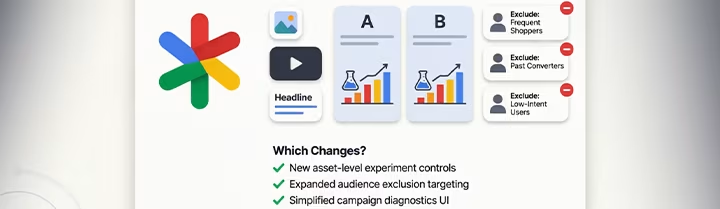 Performance Max in 2026: Asset Experiments, New Audience Exclusions, and What Actually Changed
-
 Should You Let an AI Agent Run Your Ad Campaigns? A Dubai Marketer's Honest Take
-
 AI Overviews vs AI Mode: What Changed in Google Search in 2026 (And What Dubai Businesses Should Do About It)
-
 Google Ads Is Removing Language Targeting From Search in September 2026 & What It Means for Your EN/AR Campaigns
-
 Google Says GEO Isn't a Separate Strategy From SEO— What That Actually Means for Dubai Businesses
Get a Growth Plan, Not Just a Quote
Seeking expert digital marketing, web design, or graphic design in the UAE? Let's discuss your project and deliver tailored solutions for measurable growth.
Book Free Consultation